CapitaLand China Trust: An 8.1% Yield, or a Warning Light?
CapitaLand China Trust sits near its 52-week low on an 8.1% yield. We test whether the payout is covered or quietly shrinking.
Units of CapitaLand China Trust (SGX: AU8U) closed at S$0.600 in the latest session, down 0.83% on the day and 3.23% over the past five sessions. That leaves the price just 1.69% above its 52-week low of S$0.59, 25.9% below the 52-week high of S$0.81, and down 23.57% since the start of the year. Volume of about 851,000 units was roughly half the 20-day average of 1.57 million, so this was drift rather than a rush for the exits.
Some of the weakness looked market-wide. The Straits Times Index fell 1.43% to 5,109.13 on the same day, with a 14-day RSI of 24.6, a reading that usually points to heavy selling across the board rather than one company’s problem. The units appear to have been sold alongside the market.
What makes this interesting for income investors is the number underneath the price. At S$0.600, the 8.1% yield in the data is one of the higher figures on SGX. The question is whether that is compensation or a warning.
What CLCT actually owns
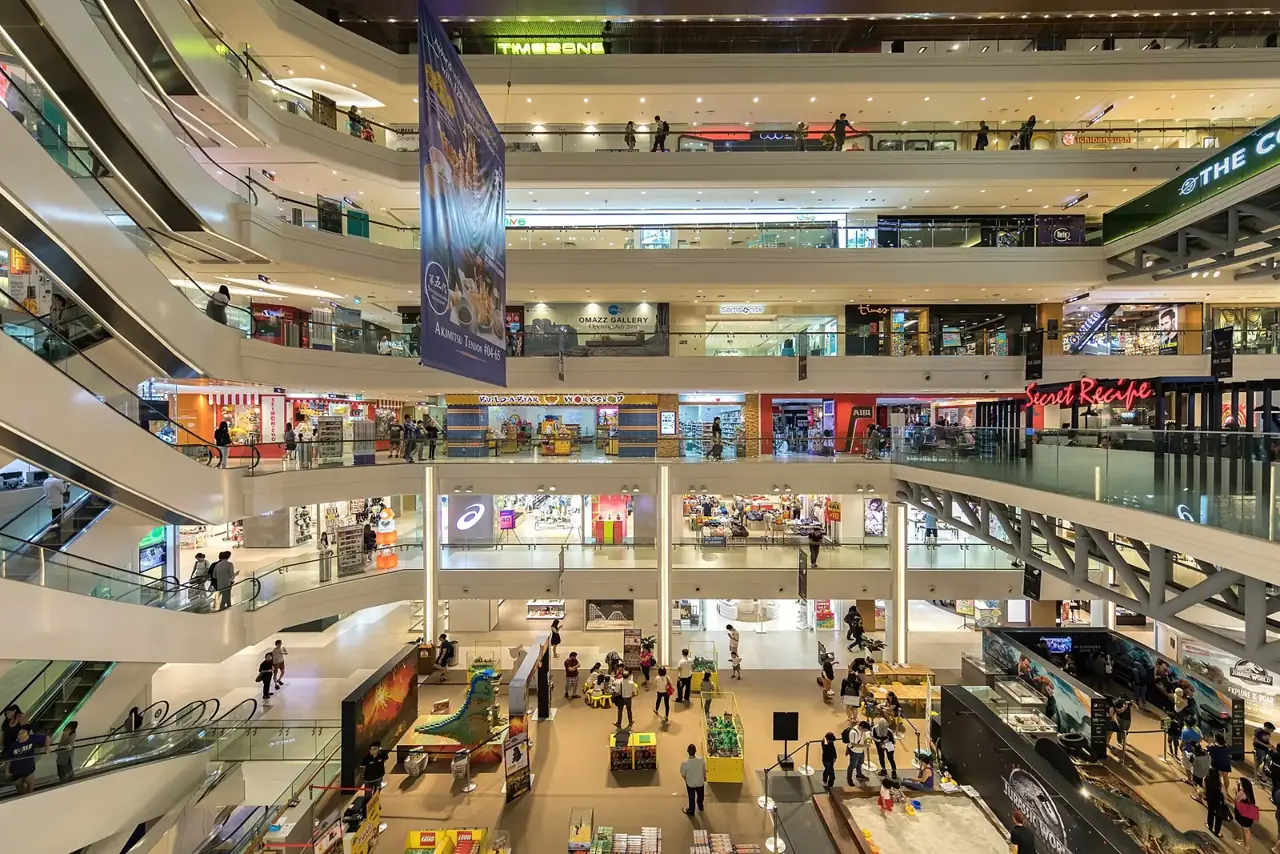
CLCT is Singapore’s largest China-focused REIT, with about S$4.6 billion of assets as at 30 June 2026: eight retail malls, five business parks and four logistics properties across Tier 1 and Tier 2 Chinese cities.
Retail is the engine. It contributed 70.6% of gross rental income in the first half, business parks 26.0% and logistics 3.4%. Income comes from leasing space to mall tenants on turnover-linked and fixed rents, and to corporate tenants in business parks and warehouses on multi-year leases. The trust reports in Singapore dollars but earns in renminbi, which matters both ways: a stronger RMB flattered 9M 2026 results, and a weaker one would do the opposite.
Where the 8.1% comes from
CLCT pays a half-yearly distribution. The 8.1% figure in the data is the annualised 1H 2026 payout of 2.45 cents divided by S$0.600. On the actual last 12 months of distributions (2.33 cents plus 2.45 cents, or 4.78 cents), the trailing yield is closer to 8.0%.
The trend is the part that deserves attention.
| Period | DPU (S cents) |
|---|---|
| 1H 2024 | 3.01 |
| 2H 2024 | 2.64 |
| FY 2024 | 5.65 |
| 1H 2025 | 2.49 |
| 2H 2025 | 2.33 (includes 0.33 cent top-up) |
| FY 2025 | 4.82 |
| 1H 2026 | 2.45 |
Two things stand out. First, FY 2025 DPU of 4.82 cents was 14.7% below FY 2024’s 5.65 cents. Second, part of the 2H 2025 number was not earned: the manager paid a 0.33 cent top-up, drawn from past divestment gains and funded through debt, to replace income lost when CapitaMall Yuhuating was sold. Strip that out and the underlying second-half payout was 2.00 cents.
Recent results
For 9M 2026, gross revenue fell 4.8% year on year to RMB1,222.3 million and net property income fell 3.9% to RMB820.6 million. On a same-store basis, which removes the Yuhuating divestment, revenue slipped 1.5% and NPI 0.8%. In Singapore dollar terms, 9M NPI actually rose 1.9%, helped by a 2.6% stronger RMB.
The operating picture is mixed but not broken. Retail occupancy was 97.2%, business parks 85.7%, logistics 98.6%. Shopper traffic rose 1.9% and tenant sales 3.5%, with sales up 8.4% excluding automobiles, ahead of China’s 1.1% retail sales growth over the same period, per the manager’s credit commentary. Completed asset enhancement works at three malls are feeding through.
The soft spot is pricing. Rental reversions were negative in every segment: minus 3% for retail, minus 12.6% for business parks, minus 1.3% for logistics. The manager frames the retail figure as deliberate strategic lease actions to upgrade two anchor spaces, which is plausible, but it still means renewing leases at lower rents.
Balance sheet: the part that matters most
This is where the yield’s durability is decided.
| Metric (30 Sep 2026) | CLCT |
|---|---|
| Aggregate leverage | 41.4% |
| Average cost of debt | 3.04% |
| Interest coverage ratio | 3.0x |
| Fixed-rate borrowings | 66% |
| RMB-denominated debt | 70% |
| Average debt maturity | 2.7 years |
Interest cover of 3.0x clears the 1.5x minimum under MAS rules, and 70% RMB debt is a sensible natural hedge against the currency of its income. The cost of debt is genuinely low, and interest savings of 16% year on year in the first half were a big reason DPU held flat.
But leverage of 41.4% is high by S-REIT standards, where the regulatory ceiling is 50%. More importantly, 62.7% of borrowings mature between 2027 and 2029, which means CLCT will be refinancing into whatever rates and credit conditions exist then. First-half cash distributions of S$52.4 million slightly exceeded free cash flow after interest and capex of S$48.3 million. That gap was small and partly timing, but it shows there is not much spare cash for paying down debt.
Valuation: cheap, or cheap for a reason
CLCT has no meaningful P/E because fair-value and currency movements swing reported earnings, and 1H 2026 came in as a net loss. Price to book is the better anchor: at 0.57 times, units trade at roughly 43% below book value of about S$1.05 per unit as at 30 June 2026.
That discount tells you the market does not fully believe the book. If Chinese mall and business park valuations soften further, NAV falls, leverage rises without any new borrowing, and the discount can persist for a long time.
I could not verify like-for-like yields for China-focused peers for this piece, so treat the 8.1% as a standalone figure rather than a relative bargain call. Broker sentiment has been cautious: OCBC Investment Research moved CLCT from Sell to Hold in March 2026 with a S$0.655 target, and the current price is below that level.
The bull case
High occupancy across all three segments, with retail near 97%. Tenant sales growing faster than the national retail sales trend. Interest costs coming down, with 66% of debt fixed and 70% in RMB. A sponsor in CapitaLand that has shown it can recycle capital, as the Yuhuating sale demonstrated at a premium to valuation. And an 8% trailing yield that, if held, does a lot of work even if the price goes nowhere.
The bear case
Negative rental reversions everywhere, and a lot of leases to get through: 41.5% of retail gross rental income expires in 2027, and around 67.4% of business park income expires across 2027 and 2028, with business park occupancy already down from 91% in FY2023 to 85.7%. Leverage at 41.4% with 62.7% of debt to refinance by 2029. A payout that has fallen two years running, with one half supported by a debt-funded top-up. And the structural risk that a China property recovery keeps being deferred.
The bottom line
CLCT is not a broken REIT. Occupancy is high, the malls are still leasing, and the interest bill is being managed well. But an 8.1% yield is doing a lot of heavy lifting in the story, and it comes with a distribution that has declined, a balance sheet with less slack than most peers, and rental renewals that are currently being signed below previous levels.
The key metric is DPU per half rather than the headline yield. If 2H 2026 comes in around 2.45 cents without a top-up, the payout is holding and the discount to book looks generous. If it needs another top-up, or if rental reversions stay negative through the 2027 expiry wave, the yield is telling you something the price already suspects.