Democrats Swept the US Midterms: What It Means for the STI, Banks and REITs
A Democratic sweep removed a political unknown, yet the STI closed flat as bank earnings drove the tape. Here is how Washington reaches Singapore stocks.
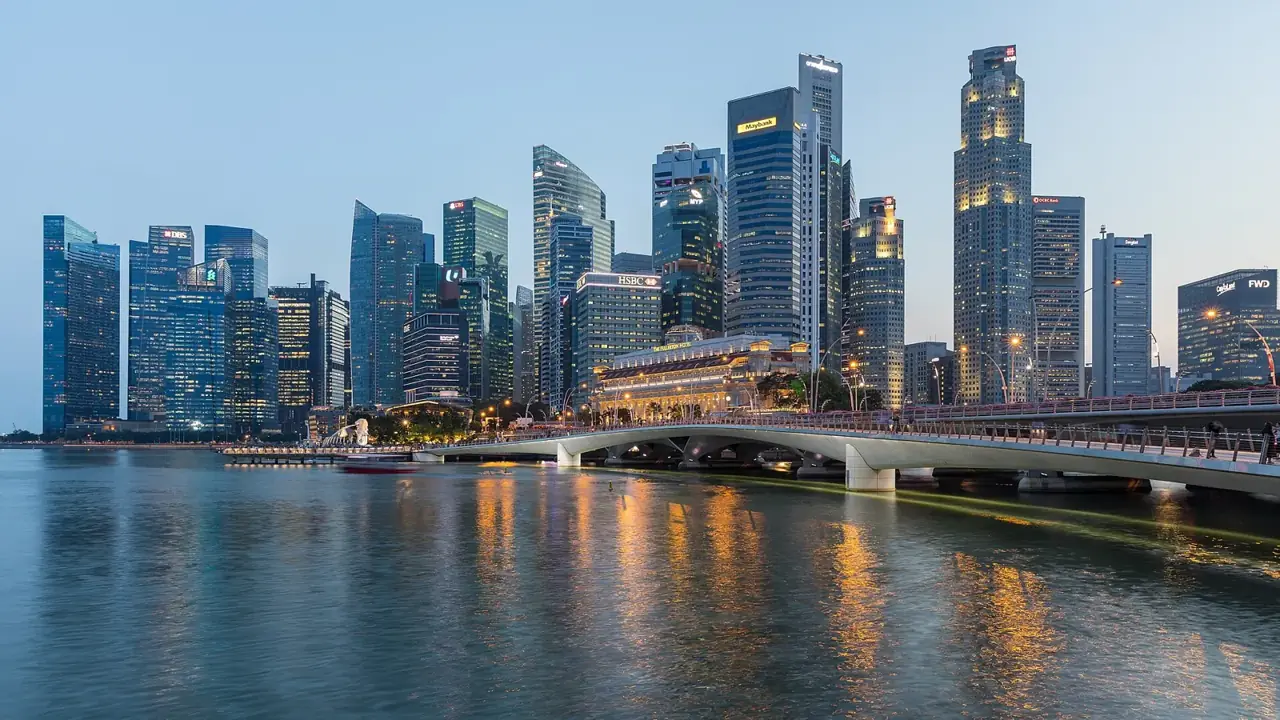
The Straits Times Index closed the 4 November session at 5,268.63, a fall of 0.01% that hides a more eventful few hours. The index was down 0.7% at 5,231 around midday, according to Trading Economics, then recovered to finish almost exactly where it began.
That leaves the benchmark 9.19% below its 52-week high of 5,801.96 and 7.59% lower over the past month, with a 14-day RSI of 22.2. In plain terms, Singapore’s market had been sold hard for weeks before Americans voted, and the result did not change the direction on the day.
Wall Street saw the same result and reacted very differently. The Dow Jones Industrial Average rose 3.03% to 53,356.12, its best session since 2025 according to Bloomberg. The S&P 500 added 1.58% to 7,688.62 and the Nasdaq Composite 1.44% to 25,736.51.
Asia held the outcome first and closed flat. New York rallied hours later. Understanding why is the key to reading the next few weeks for Singapore stocks.
What the voters decided, and what is not final
Democrats won control of both chambers of Congress, according to projections reported by BBC, CGTN and Anadolu. The Senate stood at 54-44 in the Democrats’ favour with two seats still to be called, while the party had at least 228 House seats against 139 for Republicans as of Wednesday morning GMT, with dozens of districts still counting. Democrats also expanded their grip on governorships.
Two races remain genuinely open. Alaska’s Senate contest uses ranked-choice ballots and the state allows 10 to 15 days for mailed ballots to arrive, so the BBC reports it could take weeks.
The new Congress is seated in January 2027, which is when the change in legislative power becomes operational. Until then, this is a verdict, not yet a policy.
Why New York rallied, and why Asia did not
Three channels did the work in the United States.
First, oil. Brent crude fell nearly 9% to settle at US$94.62 a barrel, on hopes that a Congress with oversight could push the Iran conflict towards an endgame. The S&P 500 energy sector fell 4.77%.
Second, bonds. The US 10-year Treasury yield dropped 6.62 basis points to 4.88% as investors bet that divided government constrains new spending and borrowing. Lower long-end yields help richly valued equities and rate-sensitive sectors.
Third, relief. Futures had fallen sharply before the open, with Nasdaq-100 contracts down as much as 2.4%, before reversing. Financials rose 3.46% and consumer discretionary 4.27%.
Asia’s problem on 4 November was domestic. UOB (SGX: U11) fell 4.99% after third-quarter results that grew year on year but came in below market expectations, according to Trading Economics. With DBS (SGX: D05) and OCBC (SGX: O39) due to report on 5 and 6 November, investors were pricing bank risk, not election risk.
Four wires from Washington to Singapore
US rates and the Fed
This is the most important wire. The Fed left its target range at 3.75% to 4.00% on 28 October on a 10-2 vote, with two policymakers preferring a hike, and US inflation ran at 3.7% in September. Markets were pricing another 25 basis point increase in December, per Trading Economics.
A Democratic Congress does not set the funds rate. What it can change is the term premium on long bonds, which is exactly what fell on 4 November. For Singapore, short-term rates track US policy closely, so the December decision still dominates local borrowing costs. But the long end feeds into how banks mark their bond portfolios, a pressure Morningstar analyst Kathy Chan linked to the October selling in Singapore bank shares.
The dollar
The dollar index slipped 0.23% while gold jumped 3.49% to US$4,065.80 an ounce, a combination that says investors trimmed US exceptionalism rather than fled risk. A softer dollar generally helps Asian assets. The Singapore dollar is managed against a basket of currencies, so a broad greenback move feeds through with a lag rather than immediately. One session is not a trend.
Trade and tariffs
Gridlock constrains legislation. It does not constrain the executive branch, and tariff policy sits largely with the White House. Washington retains significant influence through administrative means even with a hostile Congress. For Singapore exporters, the tariff risk premium does not vanish because of a vote count.
China and risk appetite
I found no clear China-specific policy signal in the result. Jardine Matheson (SGX: J36) rose 2.63% and Hongkong Land (SGX: H78) 2.54% in the Singapore session, and I found no company announcement behind either move, so the moves look more like rotation than an election read-across.
What history says, and what it cannot tell you
The historical record is genuinely encouraging, with caveats. Fidelity research, as reported by Nasdaq, found the S&P 500 was higher 12 months after every midterm since 1938. BlackRock calculates the S&P 500 averaged a 14.1% gain in the six months after midterms since 1970, against 5.7% in non-midterm years.
BlackRock also found a relevant nuance: when one party lost its trifecta, as happened here, the six-month gain averaged 10.4%, against 16.1% when power was gained or Congress stayed divided. Carson Group data cited by Nasdaq shows the S&P 500 higher in the fourth quarter after midterms more than 84% of the time since 1950, averaging 6.6%.
Two caveats. This is US data applied to a Singapore index with different sector weights, and the samples are small. History describes a base rate, not a forecast.
Banks: the biggest weight, the least election exposure
The three banks are the STI’s dominant weights, with Trading Economics putting the sector at roughly 60% of the index. Their sensitivity this week is to net interest margins and credit costs, not to Capitol Hill.
| Stock | Close (S$) | 1-day | 1-month | Yield | P/B |
|---|---|---|---|---|---|
| DBS (SGX: D05) | 70.78 | -0.14% | -9.90% | 4.49% | 2.87 |
| OCBC (SGX: O39) | 27.85 | -0.21% | -13.51% | 3.37% | 2.03 |
| UOB (SGX: U11) | 38.44 | -4.99% | -12.08% | 4.35% | 1.31 |
DBS at 70.78 and OCBC at 27.85 both closed above their 200-day averages of 66.23 and 25.69, while UOB at 38.44 sits below its 200-day line of 39.58. RSIs of 20.0, 28.2 and 17.2 respectively show how stretched the selling has been. A sustained fall in US long yields would ease book-value pressure, but a December Fed hike would work the other way.
REITs: the cleanest rate channel
S-REITs are the most direct transmission mechanism, since distributions are levered to financing costs. The 4 November session gave a modest bid: CapitaLand Integrated Commercial Trust (SGX: C38U) rose 1.30% to S$2.33, CapitaLand Ascendas REIT (SGX: A17U) 1.34% to S$2.27, Mapletree Industrial Trust (SGX: ME8U) 0.58% to S$1.73 and CapitaLand Ascott Trust (SGX: HMN) 0.60% to S$0.835.
Note the ordering. Those gains came before the Treasury rally in New York, so they are not evidence the market has re-rated the sector on the election. Yields are trailing and wide: Mapletree Industrial 7.17%, CapitaLand Ascott 7.36%, Mapletree Logistics Trust (SGX: M44U) 6.61% at a flat S$1.10. Wide yields can signal value or risk, and the election did not resolve which.
Exporters, energy and industrials
Venture Corporation (SGX: V03) rose 3.94% to S$15.02, still 19.46% below its 52-week high and down 9.52% over the month. The US debate about AI data-centre scrutiny, which Wells Fargo’s Darrell Cronk said has moved up the risk list, is the relevant thread for the electronics supply chain, though I found no company news behind the move.
Singapore Airlines (SGX: C6L) fell 1.02% to S$6.81 with an RSI of 77.6, meaning it has been one of the stronger names. Cheaper jet fuel would help if the Brent move holds, but the close came before that slide.
Among energy-linked industrials, Seatrium (SGX: 5E2) gained 4.86% to S$1.94 and Yangzijiang Shipbuilding (SGX: BS6) 2.35% to S$4.80. ST Engineering (SGX: S63) added 0.51% to S$9.88; global defence names were sold as investors trimmed bets on further military spending, but its order book is largely Singapore and Asia based, so the link is indirect.
What to watch next
- 5 November: DBS third-quarter results, per Trading Economics.
- 6 November: OCBC third-quarter results. Together with UOB, these set the tone for 60% of the index.
- Coming weeks: Alaska’s Senate count and Mississippi’s recount, both capable of narrowing the Senate margin.
- December FOMC: markets price a 25 basis point hike. This is the single biggest input for S-REIT and bank arithmetic.
- Ongoing: the US 10-year yield near 4.88% and the dollar index, which tell you whether the 4 November bond rally has legs.
- January 2027: the new Congress is seated, and debt-ceiling negotiations and data-centre policy become live.
The bottom line
The election removed a known unknown. It did not remove the two things actually driving Singapore equities: bank earnings and the path of US rates. The STI’s flat close on 4 November, while New York celebrated, is a useful reminder that the wires from Washington run through bond yields and the dollar before they reach Raffles Place.
The historical base rate after midterms is friendly, and the political gridlock that markets tend to like is now the working assumption. But the immediate tests are DBS and OCBC this week and a Fed that has been hiking, not cutting. For a retail portfolio weighted towards banks and REITs, those two facts matter more than which party controls the Senate.
Sources
- US midterms 2026: Five key takeaways as Democrats sweep Congress
- GLOBAL MARKETS-World shares advance as Democrats' victory eases political uncertainty
- US Stocks Surge as Election Drives Oil Down, Fuels Tech Optimism
- 【环球财经】投资者消化美中期选举结果 纽约股市三大股指4日均显著上涨
- Jumping Hurdles: The Race to Year End | J.P. Morgan
- STI Sinks to Over 4-Month Low as Bank Stocks Weigh
- Asian shares fall as AI-linked sell-off deepens ahead of US midterm elections
- Singapore Stocks Set for Correction as Bank Profit Outlook Sours